Wednesday, March 12, 2008

The Mathematical Historian

As it commonly goes, the relationship between history and math is comparable to, well, any non-existent relationship. Expectedly, the average history student, having left the world of mathematics long, long ago, struggles to recall the process involved in a simple long division equation, let alone making that pesky remainder disappear. We tend to scoff at math, shrug our shoulders and chuckle, unaffected by the fact that one of the most logic-driven sciences is all but lost on us.

Now, for most, this is of little concern, but maybe it should be. Sure, in our future careers as academics, curators, administrators, professionals, etc., basic math will sometimes be needed, but the calculator will see us through those little roadblocks. This is fine, even mathematicians use calculators, but what about math as a discipline that stokes the brain in a way that reading and writing does not.

As stated in a previous blog, my sub-group for the Digital 513 project is using Google Earth for our presentation on comets. As I worked with the KML interface Google Earth provides in order to create information balloons, I decided that I wasn’t satisfied with the set-up of the offered template. Through a series of trial and error, I worked through the KML code, rearranging the positions of photos and text to make a cleaner, more compact balloon. After a spate of epiphanies – even code can have such an impact – I quickly learned to recognize what certain tags and attributes represented and the necessity to arrange cells in a distinct and logical order – a similar revelation I’ve had while teaching myself basic html.

Here's a screenshot of the Google Earth balloon I created:


Although I was not working through equations or perfecting a trigonometric solution, I was performing what math is in essence: a series of logical processes. More specifically, it reminded me of my days as a student of algebra. In an algebraic equation, logic plays an immensely important role, similar to working with code. If something is added or taken away, it must have uniform correspondents throughout the equation. As in KML, there must be such tags as <> at the beginning of a cell and be closed with < / tr > at the end.

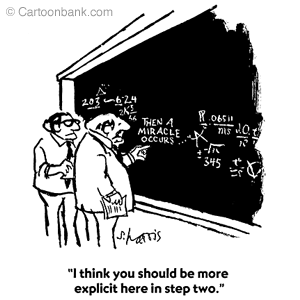
Although my ability to articulate how one works through algebra or code is quickly exhausted, it is apparent – or at least I hope it is – that they follow a similar series of input and output that require a uniform treatment of the equation or cell. If you alter a, then b and c must be adjusted or else the equation will wind up looking something like this.

On the same vein, working with code created experiences similar to those had when working with mathematical equations. After a series of errors and wrong numbers, or in the case of code, a header somehow floating between the margin and the nexus of the Internet, getting it right gives you a feeling of self-satisfaction and accomplishment. Furthermore, once you realize the mistake you were making, it becomes so obvious that you’ll never forget the logic behind the organization of the equation; a testament to the positive reinforcement of trial and error.

Well, amidst assured cries of blasphemy, I’m wondering if the historian’s apostasy and retreat from the world of mathematics - a discipline so ingrained in our little heads but soon forgotten as we entered the ivory tower of “higher learning” – should be so eagerly embraced.

We need to recognize the transferable skills that history alone cannot teach us, especially as digital humanities become increasingly important and necessary for all disciplines, including history. I’m not saying we force undergraduate or graduate students to pursue math as a secondary discipline, but a knowledge of some math, if even basic algebra, can go a long way in keeping our logic-driven left brain performing and aid us when working with the tools that will help make history more exciting, accessible, and digital.

So close that monograph on the Chilcotin Plateau, forget that lucid interpretation of Foucault, and try re-activating your left brain; don’t worry, you’re right brain could use the much needed repose.

Tuesday, February 19, 2008

Making History In Canada

As I am apt to do each and every Tuesday evening, I watch the CBC. In particular, I enjoy the comedic punditry of Rick Mercer. In last night’s episode Mercer had a compelling rant that sent me in a mad-dash of passion and frustration to my computer. As I sat there poised, preparing to applaud Mercer’s poignant wit and deplore Canada’s current political farce, I slowed my breath to come to terms with the fact that my blog is neither an outlet for my personal ravings – none of which I’m sure anyone really needs to read – nor a forum for current events outside of history. So, I cursed my historical occupation and then began to pick my brain in order to find some way to link what I had learned with some form of public history. Here goes.

But first, a little background. Each week Mercer reserves a portion of his half-hour time slot for a rant. These quick and biting monologues are most frequently aimed at the Federal Government of Canada and its routinely embarrassing acts; this week was no exception. Recently, the UN Intergovernmental Panel on Climate Change (IPCC) and Al Gore were awarded the Nobel Peace Prize in Science for their work in climate change. Apart of the IPCC were Canadian scientists who were thusly awarded this prestigious prize for their work on this study and their commitment to raising awareness of the global predicament. And how did the current Canadian government respond to the recipients of this worldly award? Well, Mercer has a wonderful, exploratory rant here.
In short, a reception for these recipients was held on parliament hill last week, but neither Stephen Harper, nor his cabinet, specifically Environment Minister, John Baird, were present to honour this achievement. The Conservatives snubbed the commemoration.

Most are familiar with the regressive environmental policies of the current Conservative government, but this is not a rant about Harper and Baird and their war on environmental science which has seen the Cabinet's science adviser relieved of his position and Environment Canada's scientists' lips sealed. This is about the history we make today and the history we celebrate.

In a recent post, a peer of mine, Helen Button, discussed the sometimes controversial art of historical commemoration. As Helen discusses, there are many lesser known figures and peoples who often go unnoticed but are nonetheless deserving of commemoration. In Canada, we often struggle with, and tip-toe around, historical idolatry for fear of alienating a specific group in an ever-growing multicultural country. Our holidays often walk the line of political correctness with days such as 'Civic Holiday' and it's new counterpart 'Family Day'. But it's not all like this. Kudos to Manitoba and the realization of its first 'Louis Riel Day'. Of course, there's Québec which has long recognized such days as 'Saint-Jean-Baptiste' and 'Dollard des Ormeaux'. Commemoration can often be controversial and Riel and Ormeaux are not without their critics and differing interpretations, but the commemoration in itself creates awareness of the impact and influence these individuals and groups have had on our history and concomitantly heritage. Yet, we still strain to create national and provincial holidays that recognize our past. And so we "observed" our first 'Family Day' in Ontario this past Monday.

Maybe part of the problem is our national government's inability to embrace our best and brightest. Governments of the past, Liberal and Conservative, have notoriously shrunk before opportunities of national recognition and unity, never committing without realizing the populist feelings of the day or presently, ignoring a commemoration of our finest minds for a static environmental platform. How are we expected to honour the achievements of the past when our current government will not honour the achievements of today? Even George W. Bush embraced Al Gore's decoration.

Whether you are a Tory or a Liberal, climate change is a reality and the Nobel Committee has recognized these Canadians' work on this study. Dealing with the reality of the environmental impact we have on Earth should not be a part of a political ideology; it should be something any government works progressively for to ensure a bright future for generations to come - this isn't Liberal environmentalism, this is foresight. And sure, the Conservative reply is that too harsh of sanctions on such things as industry and consumerism would sharply alter our way of life. But, the changes we must confront now will pale in comparison to those our children will have to face if we don't attempt to make history in a positive direction now.

Commemoration has its critics and some would argue that it does little in educating the public on history, but I argue that it is in the act of commemoration that we grow our historical awareness. Little is learned from a plaque or a statue in the park, but the presence of these historical landmarks cultivates a sense of history and heritage in communities that may lead to historical inquiry, if only amongst the few. Furthermore, these commemorations help to foster a sense of Canadian history that is so important to maintaining a strong and unified country. The Conservative response to climate change is not only damaging to Canada's reputation globally, but it cuts at the social fabric that ties Canada together through acts of commemorating our brightest. Commemorations of the past and of today do not have to place a figure or group on a pedestal, but should act as a forum for understanding. Snubbing the winners of the Nobel Peace Prize not only fails to honour that which a global committee honours, but it also hides from the discussion generated by these people and their commemoration. In my opinion, this is just plain bad for history.