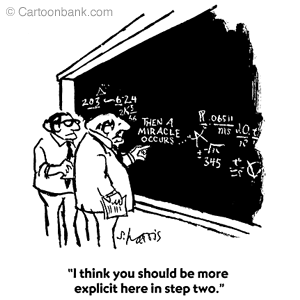
As it commonly goes, the relationship between history and math is comparable to, well, any non-existent relationship. Expectedly, the average history student, having left the world of mathematics long, long ago, struggles to recall the process involved in a simple long division equation, let alone making that pesky remainder disappear. We tend to scoff at math, shrug our shoulders and chuckle, unaffected by the fact that one of the most logic-driven sciences is all but lost on us.
Now, for most, this is of little concern, but maybe it should be. Sure, in our future careers as academics, curators, administrators, professionals, etc., basic math will sometimes be needed, but the calculator will see us through those little roadblocks. This is fine, even mathematicians use calculators, but what about math as a discipline that stokes the brain in a way that reading and writing does not.
As stated in a previous blog, my sub-group for the Digital 513 project is using Google Earth for our presentation on comets. As I worked with the KML interface Google Earth provides in order to create information balloons, I decided that I wasn’t satisfied with the set-up of the offered template. Through a series of trial and error, I worked through the KML code, rearranging the positions of photos and text to make a cleaner, more compact balloon. After a spate of epiphanies – even code can have such an impact – I quickly learned to recognize what certain tags and attributes represented and the necessity to arrange cells in a distinct and logical order – a similar revelation I’ve had while teaching myself basic html.
Here's a screenshot of the Google Earth balloon I created:

Although I was not working through equations or perfecting a trigonometric solution, I was performing what math is in essence: a series of logical processes. More specifically, it reminded me of my days as a student of algebra. In an algebraic equation, logic plays an immensely important role, similar to working with code. If something is added or taken away, it must have uniform correspondents throughout the equation. As in KML, there must be such tags as <> at the beginning of a cell and be closed with < / tr > at the end.
Although my ability to articulate how one works through algebra or code is quickly exhausted, it is apparent – or at least I hope it is – that they follow a similar series of input and output that require a uniform treatment of the equation or cell. If you alter a, then b and c must be adjusted or else the equation will wind up looking something like this.
On the same vein, working with code created experiences similar to those had when working with mathematical equations. After a series of errors and wrong numbers, or in the case of code, a header somehow floating between the margin and the nexus of the Internet, getting it right gives you a feeling of self-satisfaction and accomplishment. Furthermore, once you realize the mistake you were making, it becomes so obvious that you’ll never forget the logic behind the organization of the equation; a testament to the positive reinforcement of trial and error.
Well, amidst assured cries of blasphemy, I’m wondering if the historian’s apostasy and retreat from the world of mathematics - a discipline so ingrained in our little heads but soon forgotten as we entered the ivory tower of “higher learning” – should be so eagerly embraced.
We need to recognize the transferable skills that history alone cannot teach us, especially as digital humanities become increasingly important and necessary for all disciplines, including history. I’m not saying we force undergraduate or graduate students to pursue math as a secondary discipline, but a knowledge of some math, if even basic algebra, can go a long way in keeping our logic-driven left brain performing and aid us when working with the tools that will help make history more exciting, accessible, and digital.
So close that monograph on the Chilcotin Plateau, forget that lucid interpretation of Foucault, and try re-activating your left brain; don’t worry, you’re right brain could use the much needed repose.